

Navigating property taxes in the UK has become increasingly complex. Between frozen personal allowances, stricter reporting requirements, and shifting tax rates, buy-to-let investors must stay proactive to safeguard their yields.
Whether you operate a single residential buy-to-let in Oldham, manage a growing portfolio across Greater Manchester, or rent out property as a secondary income stream, understanding your tax obligations is critical.
This guide breaks down everything you need to know about rental income tax in the UK for 2026, allowable expenses, Making Tax Digital (MTD), and strategies to optimize your property business.
How Is Rental Income Taxed in the UK for 2026/27?
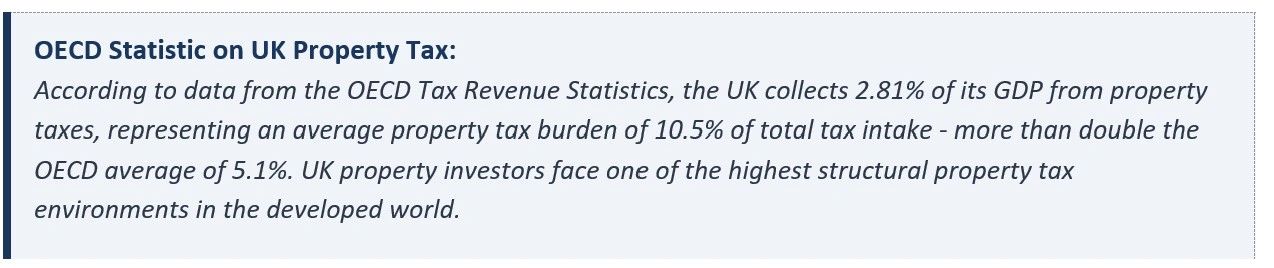
In the UK, rental profit is treated as non-savings income and added to your total taxable earnings (salary, dividends, pension) to determine your marginal tax band.
UK Income Tax Bands for 2026/27 (England, Wales & Northern Ireland)

The Income Taper & Effective 60% Tax Trap
If your total gross income (including net rental profits) reaches between £100,000 and £125,140, your £12,570 Personal Allowance is reduced by £1 for every £2 earned above £100,000. This creates an effective marginal tax rate of 60% on income within this bracket before accounting for mortgage interest relief restrictions.
Key Landlord Tax Changes Taking Effect in 2026 (And Beyond)
1. Making Tax Digital (MTD ITSA) Is Now Live
As of 6 April 2026, HMRC’s Making Tax Digital for Income Tax Self Assessment (MTD ITSA) is officially mandatory for landlords and self-employed individuals with gross qualifying income exceeding £50,000. Under MTD ITSA, affected landlords must:
- Keep digital accounting records of all income and property expenses.
- Submit quarterly updates to HMRC using MTD-compatible software.
- Submit a Final Declaration by 31 January following the tax year end to replace the traditional annual Self Assessment tax return.
Xero Industry Insight: Analysis from cloud accounting provider Xero highlights that over 50% of small property businesses struggle with manual bookkeeping errors and cash-flow visibility when transitioning away from spreadsheets. Implementing software like Xero paired with property management tools (such as Landlord Studio) eliminates manual entry and guarantees compliance with HMRC’s MTD rules.
(Note: The MTD threshold will lower to £30,000 in April 2027 and £20,000 in April 2028).
2. Confirmed Property Income Tax Rate Increases for 2027
While standard income tax bands remain frozen, HMRC policy legislation introduced in Finance Bill 2025–26 creates a separate, higher tax regime specifically for property income starting 6 April 2027:
- Property Basic Rate: 22% (up from 20%)
- Property Higher Rate: 42% (up from 40%)
- Property Additional Rate: 47% (up from 45%)
HMRC Impact Analysis: According to official HMRC policy costings, an estimated 2.4 million landlords (representing 6% of all UK taxpayers) will see an immediate increase in their tax liability when these property rates take effect.
The policy also provides that finance cost relief for individual landlords will be given at the new property basic rate of 22% from April 2027.
Source: HMRC Policy Paper, published 27 November 2025 Income Tax — Changes to Tax rates for Property, Savings and Dividend Income – GOV.UK
Section 24 Mortgage Interest Relief: What Landlords Need to Know
Under Section 24 restrictions, individual landlords cannot deduct mortgage interest or finance costs from gross rental income to calculate taxable profit. Instead, finance costs are rewarded as a 20% basic rate tax credit subtracted from your final tax bill.
Worked Example: How Section 24 Impacts Cash Flow (2026/27)
Imagine a higher-rate taxpayer (40%) earning £20,000 in gross rental income with £10,000 in mortgage interest and £2,000 in general repairs:
1. Gross Profit Subject to Tax: £20,000 – £2,000 (repairs) = £18,000
2. Initial Tax Liability (40%): 40% of £18,000 = £7,200
3. Section 24 Tax Credit: 20% of £10,000 (mortgage interest) = £2,000
4. Final Tax Payable: £7,200 – £2,000 = £5,200
5. Actual Cash Retained: £20,000 (rent) – £10,000 (mortgage) – £2,000 (repairs) – £5,200 (tax) = £2,800 net profit
Because tax is calculated on gross income rather than net profit after finance costs, highly leveraged landlords face significantly inflated tax bills – a major reason many investors choose to incorporate.
Allowable Expenses for UK Landlords in 2026
To reduce your taxable property profit, you can deduct “wholly and exclusively” incurred operational expenses from your rental income.
What You CAN Claim:
- Property Maintenance & Repairs: Direct repairs such as fixing a roof leak, painting between tenancies, or servicing a boiler (excluding structural capital improvements).
- Safety Certificates: Gas safety checks, Electrical Installation Condition Reports (EICR), and Energy Performance Certificates (EPC).
- Insurances: Landlord insurance, building and contents insurance, loss of rent cover.
- Professional Fees: Letting agency management fees, legal fees for short-term lets/tenancy agreements, and accountancy fees for preparing property accounts.
- Utilities & Council Tax: Rates paid by you during void periods or under inclusive tenancy agreements.
What You CANNOT Claim:
- Capital Improvements: Expenses that add value or upgrade the property (e.g., adding an extension or upgrading to luxury fittings). These costs offset Capital Gains Tax (CGT) upon sale rather than rental income tax.
- Mortgage Principal Repayments: Only mortgage interest qualifies for the 20% tax reduction.
The £1,000 Property Income Allowance
If your total gross rental income is less than £1,000 in a tax year, it is completely tax-free under the Property Allowance. You do not need to report this income to HMRC unless you choose to claim actual expenses that exceed £1,000.
Step-by-Step: Filing Your UK Landlord Tax Return
- Register with HMRC: If you earn over £1,000 in gross rental income, register for Self Assessment (or MTD if income exceeds £50,000).
- Organise Digital Records: Track rental payments, invoice receipts, and bank statements monthly using digital software.
- Calculate Allowable Expenses: Separate revenue maintenance expenses from capital improvement costs.
- Submit Quarterly Updates (if MTD applies): Submit digital summaries of income and expenses within 1 month following each quarter-end.
- Submit Final Declaration & Pay Tax: Complete your final declaration and settle your tax liability by 31 January following the end of the tax year.
Personal Name vs. Limited Company (SPV): Which Is Better in 2026?
With Section 24 and upcoming 2027 property tax increases affecting individuals, transferring or acquiring properties via a Special Purpose Vehicle (SPV) Limited Company remains popular.
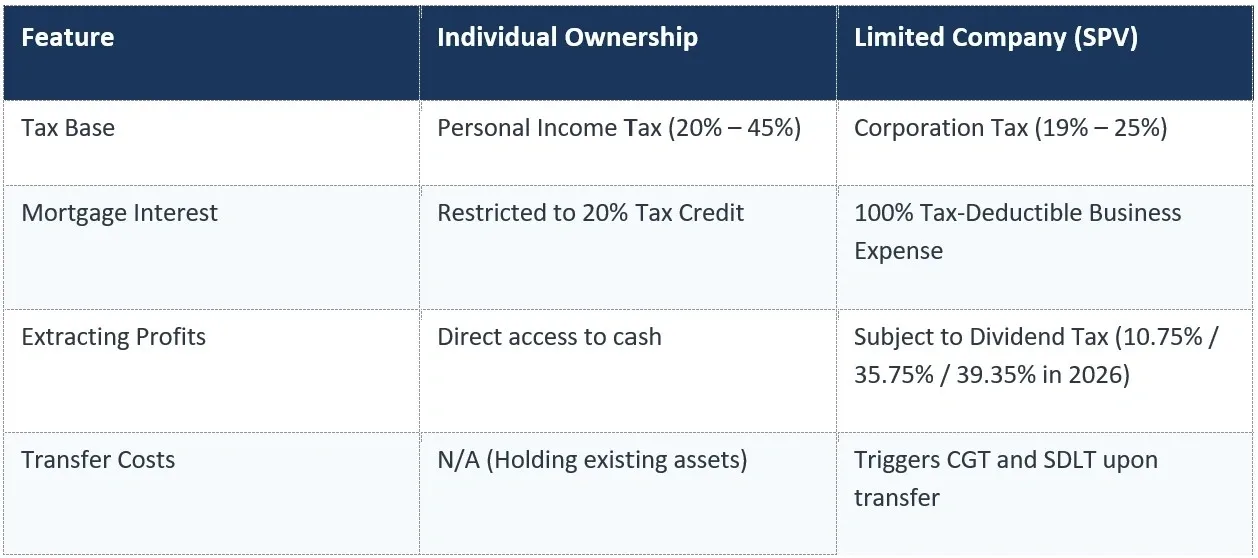
Verdict: The comparison above provides a high-level overview. However, landlords who already own property should also consider the costs and benefits of transferring existing properties into a company structure.
Should You Transfer Existing Properties Into a Limited Company?
For many landlords, one of the biggest strategic tax questions is whether to continue owning rental properties personally or transfer them into a limited company structure. While incorporation can offer substantial long-term tax benefits, it is not a straightforward decision and should be carefully assessed before proceeding.
Potential Advantages of Incorporation
A limited company may offer several benefits, particularly for higher-rate taxpayers and landlords who intend to grow their portfolio:
- Full relief for mortgage interest and finance costs, unlike personally owned properties where Section 24 restrictions apply.
- Corporation tax rates that may be lower than personal income tax rates, allowing more profit to be retained for reinvestment.
- Greater flexibility for succession planning, including gifting shares to family members over time.
- Potentially more efficient long-term wealth accumulation, especially where profits are being retained within the company rather than withdrawn personally.
For landlords looking to expand their portfolio, retaining profits within a company can often provide significantly greater funds for future property acquisitions.
Potential Costs and Risks
Transferring existing properties into a company is not simply an administrative exercise. In many cases, the transfer is treated as a disposal for tax purposes, which can trigger substantial upfront costs, including:
- Capital Gains Tax (CGT) on any increase in the property’s value since acquisition.
- Stamp Duty Land Tax (SDLT), which may be payable by the company on the market value of the property being transferred.
- Legal fees, valuation costs and mortgage refinancing expenses.
- Potentially higher mortgage interest rates and lending costs compared to personally owned buy-to-let properties.
These costs can, in some cases, outweigh the future tax savings.
Could Tax Reliefs Reduce the Cost?
Certain reliefs may be available where a landlord operates their portfolio as a genuine property business. Depending on the circumstances, the following reliefs may help reduce or defer some of the tax liabilities arising on transfer:
- Incorporation Relief
- Business Asset Disposal planning
- Partnership incorporation provisions
However, eligibility depends on the specific facts of each case, and HMRC scrutinises these arrangements carefully. Professional advice should always be obtained before commencing any incorporation process.
So, Is Incorporation Worth It?
There is no one-size-fits-all answer. For some landlords, particularly those in the situations below incorporation can produce substantial tax savings over time:
- Multiple properties
- Significant mortgage borrowing
- Higher-rate and additional-rate tax exposure
- Long-term growth plans
For others, especially where properties have large unrealised gains or where profits are required for personal living expenses, remaining in personal ownership may be more beneficial.
Our Advice
At ATS Accountants, we regularly undertake detailed cost-benefit analyses for landlords considering incorporation. We assess:
- Current and future tax liabilities.
- Potential CGT and SDLT exposure.
- Mortgage and financing implications.
- Succession and inheritance planning opportunities.
- Expected payback periods for incorporation costs.
A properly structured review can often identify tax savings worth tens of thousands of pounds over the long term, while avoiding costly mistakes that arise from transferring properties without fully understanding the consequences.
Thinking about incorporating your property portfolio? Contact ATS Accountants for a personalised landlord tax review before making any decisions. Contact ATS Accountants
How ATS Accountants Supports Landlords in Oldham & Greater Manchester
Managing property tax compliance requires proactive planning, especially with HMRC tightening scrutiny around unrecorded rental income and landlord tax filings.
At ATS Accountants, we help property investors, buy-to-let landlords, and property businesses across Rochdale, Oldham, Chadderton, Greater Manchester and St Helen’s navigate changing tax laws smoothly. Contact ATS Accountants
Our Property Tax Services Include:
- MTD ITSA Setup & Integration: Connecting your property accounts to HMRC-compliant software like Xero.
- Portfolio Structuring Advisory: Evaluating whether personal ownership or SPV incorporation is most profitable for your goals.
- HMRC Dispute & Enquiry Defense: Protecting your interests and resolving landlord tax investigations effectively (including saving clients thousands in penalties and interest).
- Self Assessment & Property Tax Returns: Accurately claiming every allowable expense to minimise your overall tax burden.
Further Recommended Reading
Whether you’re managing a single buy-to-let property or a substantial property portfolio, understanding the wider tax and compliance landscape can help you maximise profits and avoid costly mistakes. The following guides and services may also be useful:
- Preparing for Making Tax Digital 2026 UK – All You Need To Know
- Received an HMRC Letter About Rental Income? Real Client Story
- Switching Accountants in the UK: What You Need to Know
- HMRC Investigations | Expert Accountant Representation
- Tax Planning Services | ATS Accountants
- Core Accounting Services | ATS Accountants