
Independent Examination vs Audit: Why the Difference Matters
One of the most common questions charity trustees ask is whether their charity needs an independent examination or a statutory audit.
At first glance, the two may seem similar. Both involve an external review of a charity’s accounts. Both aim to support transparency and accountability. Both can help trustees demonstrate that they are taking their financial responsibilities seriously.
However, an independent examination and an audit are not the same. They provide different levels of scrutiny, follow different procedures and offer different levels of assurance.
Understanding the distinction is particularly important because charity reporting thresholds are changing from 30 September 2026. For many charities in England and Wales, the changes will affect whether they need an independent examination, whether the examiner must be professionally qualified, and whether a statutory charity audit is required.
For trustees, the issue should not simply be: “What is the minimum legal requirement?”
A better question is: “What level of financial scrutiny is appropriate for our charity’s size, funding, risks and governance responsibilities?”
That is why this topic links closely with our separate article on Financial Governance for Charity Trustees, where we explain the wider role trustees play in protecting charitable funds, asking the right questions and maintaining public trust.
What Is an Independent Examination?
An independent examination is a form of external scrutiny available to many charities in England and Wales.
It is generally less detailed than an audit. The independent examiner reviews the charity’s accounting records and compares them with the accounts prepared by the charity. The examiner also considers whether any unusual items, disclosures or matters require explanation from the trustees.
The examiner’s role is not to carry out a full audit. An independent examination does not provide an audit opinion and does not confirm that the accounts give a “true and fair view”. This distinction is reflected in independent examiner wording used in charity accounts, where the examiner explains that the procedures undertaken do not provide all the evidence that would be required in an audit and therefore no audit opinion is given.
For many smaller and medium-sized charities, an independent examination provides a proportionate level of external review. It helps trustees meet their legal responsibilities while avoiding the higher cost and more extensive procedures associated with a full audit.
An independent examination can be particularly suitable where:
- the charity’s income is below the statutory audit threshold;
- the charity’s operations are relatively straightforward;
- accounting records are complete and well maintained;
- there are no complex funding, property or trading arrangements; and
- no funder or governing document requires an audit.
However, trustees should remember that an independent examination is still a serious regulatory process. It is not a rubber-stamping exercise.
What Is a Charity Audit?
A charity audit is a much more detailed review of the charity’s financial statements.
An audit is carried out under UK auditing standards. The auditor performs risk assessment work, tests transactions and balances, considers internal controls, reviews evidence and forms an opinion on whether the accounts give a true and fair view.
A statutory audit provides a higher level of assurance than an independent examination. Naturally, the cost is also significantly higher.
An audit may involve:
- review of income recognition;
- testing grants, donations and restricted funds;
- checking expenditure and supporting documentation;
- reviewing bank balances and reconciliations;
- considering internal controls and governance risks;
- reviewing trustees’ annual report disclosures;
- assessing whether the charity is a going concern; and
- considering whether there are reportable matters for regulators.
For larger charities, charities with complex restricted funds, grant-funded charities, property-owning charities or organisations handling public money, an audit may provide important assurance to trustees, funders, regulators and stakeholders.
Independent Examination vs Audit: Key Differences
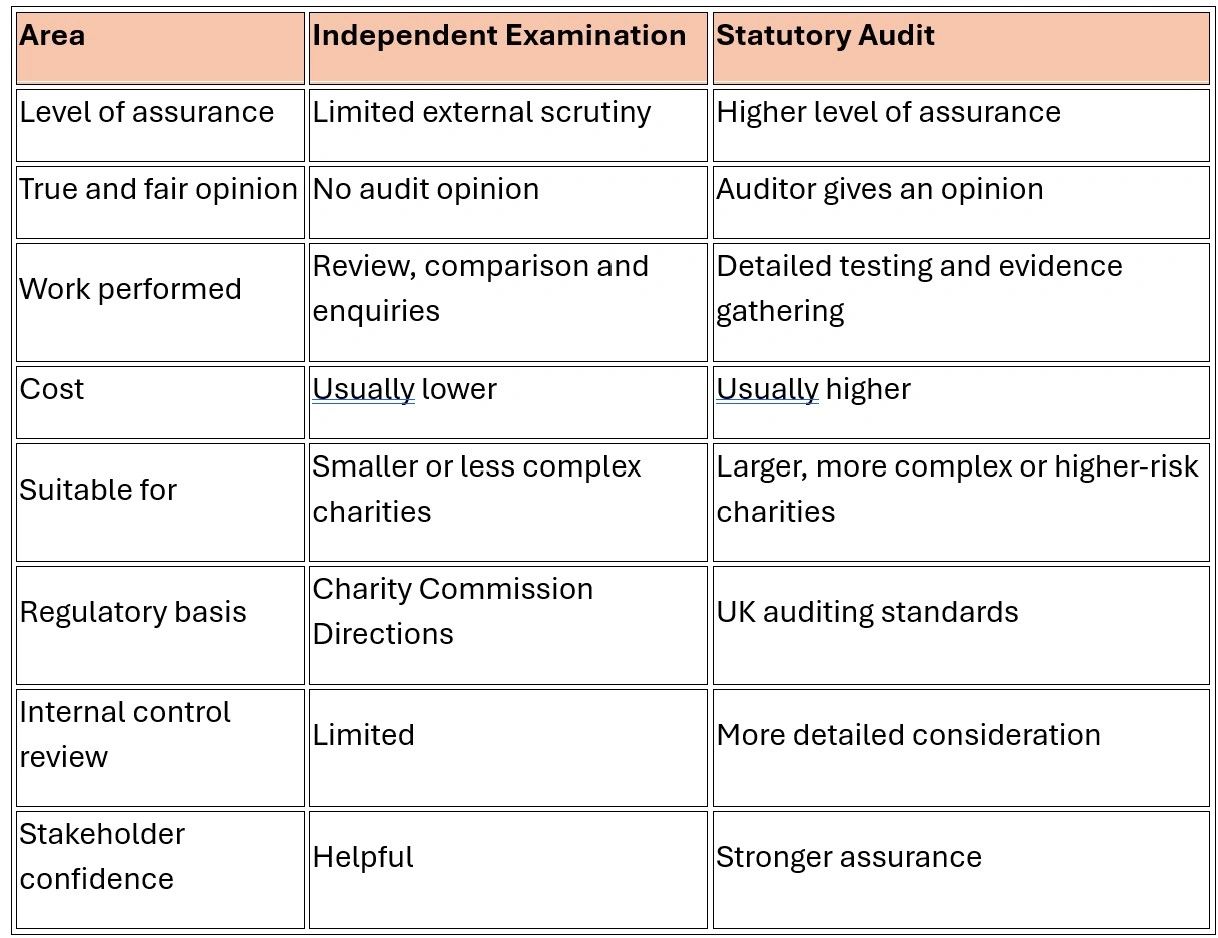
This difference matters because trustees remain responsible for the accounts, financial controls and stewardship of charitable funds regardless of whether the charity has an independent examination or an audit.
Current Charity Independent Examination and Audit Thresholds
Trustees searching for charity audit thresholds, independent examination threshold charity, or charity accounts audit requirements need to be careful because the rules are changing.
At the time of writing, the current thresholds for charities in England and Wales are broadly as follows.
Current Independent Examination Threshold
A charity with gross annual income over £25,000 must normally have its accounts independently examined if it is not required to have an audit.
Where a charity’s income is over £250,000, the independent examiner must be professionally qualified.
Current Charity Audit Threshold
A charity generally requires a statutory audit where:
- gross annual income is over £1 million; or
- gross assets are over £3.26 million and income is over £250,000.
Changes to charity accounting and reporting – GOV.UK sets out the current audit thresholds as income over £1,000,000, or assets over £3,260,000. New financial thresholds: effective 30 September 2026.
Trustees should also check whether the charity’s governing document, funders, lenders or grant agreements require an audit even where charity law does not.
Charity Independent Examination and Audit Threshold Changes from 30 September 2026
The charity reporting landscape is changing significantly.
From 30 September 2026, new charity accounting and reporting thresholds are expected to apply to accounting years ending on or after that date.
The key changes are:
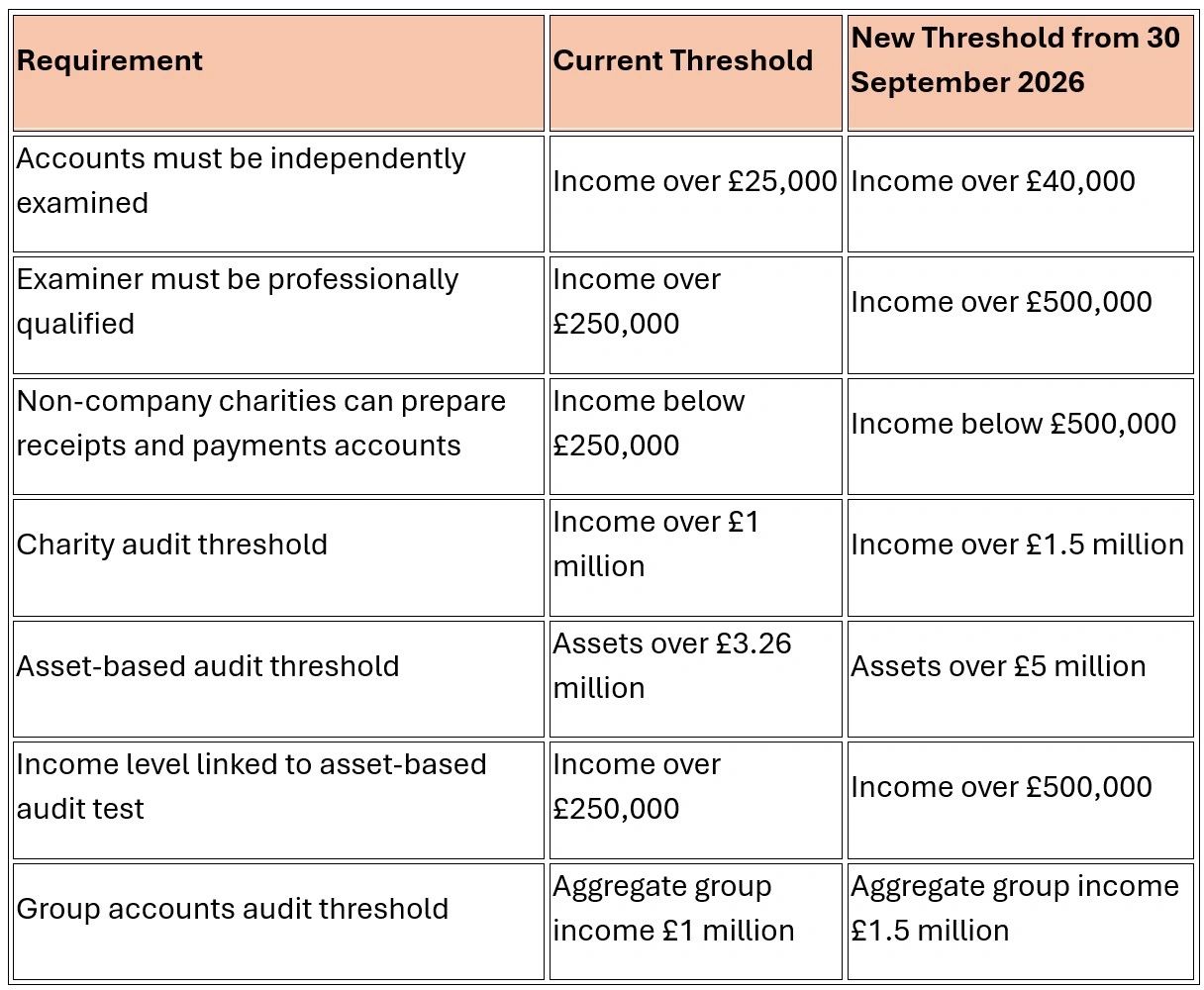
These changes are significant for trustees, treasurers and charity finance teams. They mean that some charities currently requiring an audit may move below the new charity audit threshold 2026, and some charities currently requiring a qualified independent examiner may no longer need one under the revised rules. New financial thresholds: effective 30 September 2026 | ICAEW confirms that the audit income threshold will rise from £1 million to £1.5 million, the asset-based audit threshold will rise from £3.26 million to £5 million, and the independent examination threshold will rise from £25,000 to £40,000.
However, the threshold changes should not be viewed only as a cost-saving opportunity. A charity may still benefit from an audit even if one is no longer legally required.
Should Trustees Still Choose an Audit Below the Threshold?
In some cases, yes.
Some charities may fall below the statutory audit threshold but still decide that an audit is appropriate. Trustees may choose this route where the additional assurance is helpful for governance, funders, donors or public confidence.
A voluntary audit may be worth considering where:
- the charity has complex restricted funds;
- the charity receives significant grants or public funding;
- the charity owns property or other high-value assets;
- there have been historic weaknesses in financial controls;
- there are concerns about fraud, missing records or unsupported transactions;
- the charity is growing quickly;
- trustees want stronger independent assurance; or
- funders expect audited accounts.
The most important point is that trustees should not make the decision purely by looking at the legal threshold. They should also consider risks, complexity, stakeholder expectations and the strength of the charity’s internal controls.
This is where financial governance becomes critical. Our companion article, Financial Governance for Charity Trustees, explains how trustees can improve oversight through better reporting, stronger controls and a culture of appropriate challenge.
Case Study: Supporting Trustees with Suspicious Historic Transactions
The following is an anonymised example based on our work supporting charity trustees.
A Greater Manchester based charity’s current trustees became concerned about historic transactions that had taken place under a previous committee. The transactions were significant, but the charity did not hold sufficient supporting documentation to explain them properly.
The trustees wanted to deal with the matter responsibly. They needed to understand what had happened, whether the transactions could be justified, what records were missing, and what action should be taken.
As part of our work, we reviewed the accounting records, considered the available explanations, and advised the trustees on the steps they should take. Our review found that there had been weaknesses in internal controls and that certain historic transactions had no supporting documentation available.
We advised the trustees on their responsibilities and supported the matter being reported to the Charity Commission as a matter of material significance under the internal controls and governance heading in accordance with section 156 of the Charities Act 2011.
The trustees also strengthened procedures going forward, including a requirement for higher-value transactions to be approved by all three committee members and for transactions to comply with the charity’s constitution.
This case highlights an important point. Independent examination and audit thresholds are only part of the picture. Trustees must also respond appropriately when financial governance concerns arise.
Where suspicious transactions, missing records or control weaknesses are identified, trustees should act promptly, document their actions, seek professional advice where needed and consider whether the matter must be reported to the Charity Commission.
The Charity Commission’s guidance on matters of material significance explains that reports may involve failures of internal controls or failures in charity governance that resulted in, or could give rise to, significant loss, misappropriation of charitable funds or material charitable funds being put at major risk.
Why Governance Experience Matters
Charity accounting is not just about preparing accounts or checking thresholds. It is about understanding accountability, oversight and stewardship.
At ATS Accountants, our work with charities is informed by both technical accounting knowledge and practical governance experience.
Our director Shahed Alam FCPFA currently serves as Treasurer of Rochdale & District Mind, giving him direct experience of charity financial oversight, trustee reporting and governance responsibilities.
Shahed was also a founder of London Enterprise Academy, a free school in London, and has served as a school governor at various schools in Oldham in the past. These roles involved governance, accountability, board-level decision-making and oversight of organisations operating in regulated environments.
Earlier in his career, Shahed trained as a public sector auditor. That background provided practical exposure to audit discipline, public accountability, internal controls and the importance of robust financial scrutiny.
This combination of charity, education and public sector experience helps us support trustees not only with compliance, but also with the wider financial governance challenges charities face.
For more information about our specialist support, visit our Charity Accountants | ATS Accountants page.
How ATS Accountants Supports Charities
ATS Accountants works with charities across Oldham, Rochdale, Greater Manchester, St Helens and beyond.
We support charities with:
- independent examinations;
- charity accounts preparation;
- trustee reporting;
- financial governance advice;
- internal control reviews;
- support with Charity Commission reporting;
- investigation of unusual or unsupported transactions;
- charity VAT and tax advice; and
- practical guidance for trustees and treasurers.
Our aim is not simply to help charities meet minimum filing requirements. We help trustees understand what the numbers mean, identify risks early and strengthen financial oversight.
FAQs: Independent Examination vs Audit for Charities
What is the difference between an independent examination and an audit?
An independent examination is a lighter form of external scrutiny. It involves reviewing the charity’s accounting records and comparing them with the accounts. An audit is more detailed and provides a higher level of assurance, including an auditor’s opinion on whether the accounts give a true and fair view.
What is the current independent examination threshold for charities?
The current independent examination threshold is income over £25,000. Charities above this level usually need an independent examination unless they require an audit.
What is the new independent examination threshold from September 2026?
From 30 September 2026, the independent examination threshold is expected to increase from income over £25,000 to income over £40,000.
When does an independent examiner need to be qualified?
Currently, where a charity’s income is over £250,000, the independent examiner must normally be professionally qualified. From 30 September 2026, this threshold is expected to increase to £500,000.
What is the current charity audit threshold?
The current charity audit threshold is generally income over £1 million, or gross assets over £3.26 million where income is also over the relevant income threshold. New financial thresholds: effective 30 September 2026.
What is the new charity audit threshold from September 2026?
From 30 September 2026, the charity audit threshold is expected to increase to income over £1.5 million. The asset-based audit threshold is expected to increase from £3.26 million to £5 million.
Do all charities below the audit threshold need an independent examination?
Not all charities below the audit threshold need an independent examination. The requirement depends on income levels, legal structure and other factors. Currently, charities with income over £25,000 generally require independent examination unless an audit is required. From 30 September 2026, this threshold is expected to rise to £40,000.
Can trustees choose an audit even if it is not required?
Yes. Trustees may choose to have a voluntary audit if they consider it appropriate. This may be useful where the charity has complex activities, significant grant funding, property, historic control issues or funders who expect audited accounts.
Can a funder require an audit even if charity law does not?
Yes. A funder, lender or grant-making body may require an audit as a condition of funding. Trustees should check grant agreements, loan agreements and the charity’s governing document before deciding whether an independent examination is sufficient.
Does an independent examination detect fraud?
An independent examination is not designed to detect all fraud. It may identify unusual items, missing records or issues requiring explanation, but it does not involve the same level of testing as an audit. Trustees remain responsible for safeguarding charity assets and taking reasonable steps to prevent and detect fraud.
What should trustees do if suspicious transactions are found?
Trustees should act promptly. They should gather evidence, seek explanations, document their actions, strengthen controls where needed and consider whether the matter must be reported to the Charity Commission or another authority. In some cases, auditors or independent examiners may also have a duty to report matters of material significance. Charity Commission guidance refers to failures of internal controls or governance that could result in significant loss, misappropriation or charitable funds being put at major risk.
Are the 2026 charity threshold changes linked to SORP 2026?
The threshold changes are separate from the updated Charities SORP, but both affect charity reporting. Changes to charity accounting and reporting – GOV.UK states that SORP 2026 applies to reporting periods starting on or after 1 January 2026, while the accounting and examination threshold changes are expected to apply to accounting years ending on or after 30 September 2026.
Final Thoughts
The difference between an independent examination and an audit is more than a technical accounting issue. It goes to the heart of trustee responsibility, financial governance and public accountability.
The upcoming charity audit threshold changes in September 2026 will reduce the number of charities requiring a statutory audit and increase the income level at which independent examination becomes mandatory. For some charities, this may reduce administrative burden and professional costs.
However, trustees should not make decisions based solely on thresholds.
A charity may still need stronger assurance where it has significant funding, complex operations, restricted funds, historic control issues or stakeholder expectations. Similarly, an independent examination can still identify important governance points, especially where accounting records are incomplete or unusual transactions require explanation.
At ATS Accountants, we help charities understand their reporting obligations, strengthen financial governance and make informed decisions about independent examination, audit and trustee oversight.
Recommend Further Reading:
- To learn more about ATS Accountants’ work with charities, visit our Charity Accountants | ATS Accountants page.
- To learn more about financial governance, read our related article on Financial Governance for Charity Trustees: A Practical Guide.
- Are you struggling to decide between independent examination and audit for your charity? Read our article on Independent Examination vs Audit: Guide for UK Charity Trustees
- If you’d like to read reviews from our clients, please visit our Client Reviews | ATS Accountants Manchester page.