

How Strategic Tax Planning Helped a Property Investor Reassess Their Family Wealth Strategy
Many successful property investors focus on generating income and growing asset values. However, the way those assets are owned can have a significant impact on future tax liabilities and family wealth planning.
Recently, ATS Accountants worked with a high-income client who had built up a substantial property portfolio over many years. The properties had increased significantly in value and were producing healthy rental income. Like many successful investors, the client wanted to understand whether their current ownership structure remained the best option for the future.
The initial question seemed straightforward:
Would moving the properties into a limited company create a better long-term outcome for the family?
The answer turned out to be far more complex than a comparison of annual tax rates.
Looking Beyond Annual Tax Savings
Many discussions about property incorporation focus on income tax. While annual tax savings can be relevant, they are rarely the only factor that matters. Our review considered a much broader range of issues, including:
- Future family ownership
- Succession planning
- Inheritance tax exposure
- Long-term wealth preservation
- The economic value being transferred to the next generation
- The overall financial impact over many years rather than a single tax year
This wider perspective is often where professional advisory work provides the greatest value.
A strategy that looks attractive when viewed through the lens of annual tax savings can look very different once the full picture is examined.
A Surprising Discovery
As we modelled the proposed restructuring, we identified a significant issue that could have prevented the client from achieving one of their main objectives.
On the surface, the proposed arrangement appeared capable of moving future growth and wealth into a more tax-efficient structure.
However, a detailed review of the balance sheet implications revealed that simply changing ownership arrangements would not automatically deliver the inheritance tax outcome the client expected.
Without careful planning, there was a risk that the family could incur substantial implementation costs while failing to achieve the desired long-term succession objectives.
This was an important turning point in the project.
- Instead of focusing solely on whether incorporation was possible, the discussion shifted towards whether the overall strategy genuinely achieved the client’s goals.
The Real Value of Advisory Work
Many people assume tax planning is simply about paying less tax. In reality, effective advisory work is often about identifying hidden issues before expensive decisions are made.
In this case, the most valuable outcome was not a tax calculation; it was the identification of a structural issue that could have significantly reduced the anticipated long-term benefit if left unaddressed.
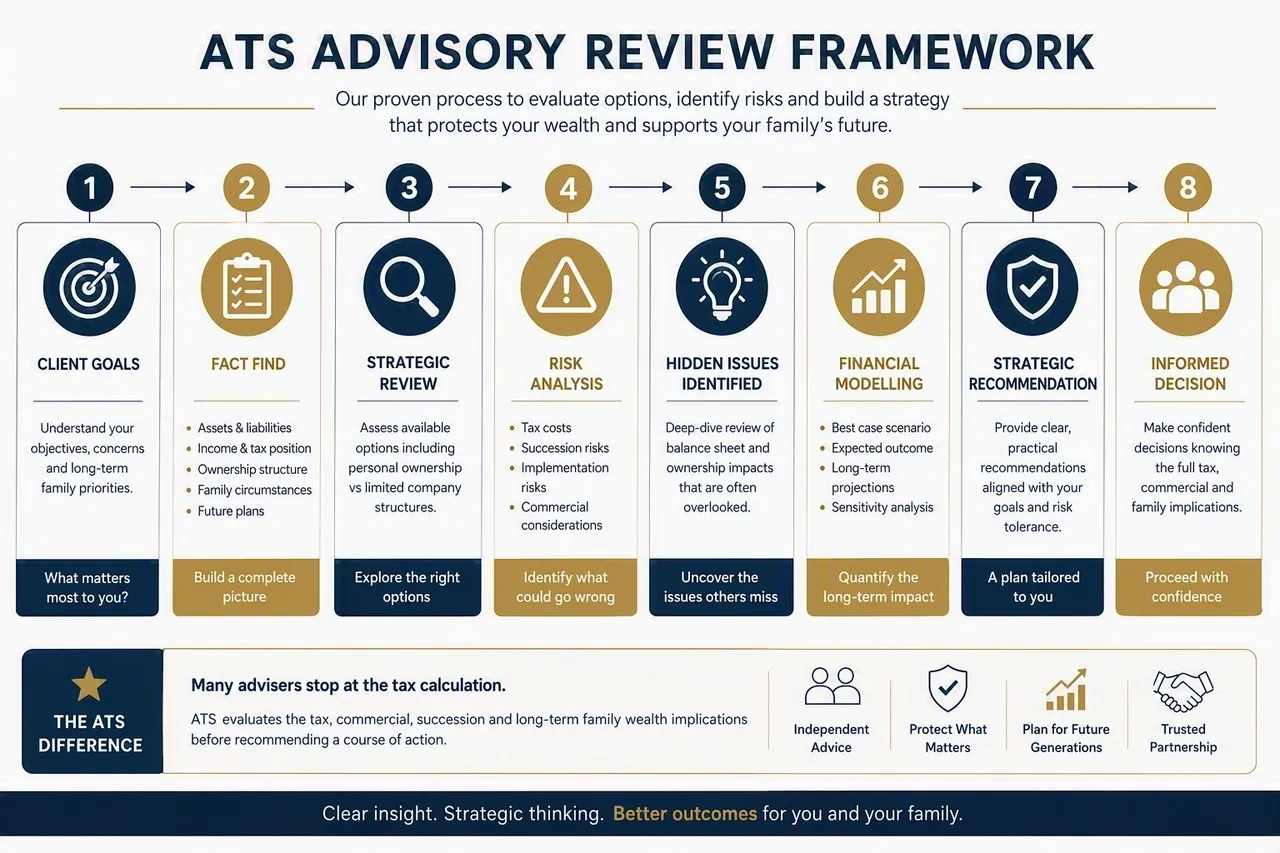
By exploring alternative options and challenging assumptions, we helped the client understand:
- The potential advantages of restructuring
- The financial trade-offs involved
- The implementation risks
- The practical considerations for future family ownership
- The conditions that would need to be satisfied before proceeding
This allowed the client to make an informed decision based on the complete picture rather than a single projected tax saving.
Why Long-Term Thinking Matters
One of the most common mistakes we see in tax planning is focusing only on today’s tax bill. Long-term wealth planning requires consideration of a much wider range of factors, including:
- Future inheritance tax exposure
- Family succession objectives
- Property growth
- Ownership structures
- Future cash flow requirements
- The interaction between tax, legal and commercial considerations
Often, the greatest opportunities arise not from reducing a single year’s tax liability, but from aligning tax planning with broader family and financial objectives. That was certainly the case here.
The client’s objectives extended well beyond annual rental profits and included preserving wealth for the next generation, protecting future growth and creating a structure that could support long-term family succession.
Every Family’s Position Is Different
There is no single solution that works for every landlord or property investor. A strategy that may be highly effective for one family could be completely inappropriate for another. Factors such as property values, borrowing arrangements, family circumstances, estate planning objectives, future income requirements and succession intentions can all significantly affect the outcome.
This is why generic online advice often falls short. Major restructuring decisions should be based on detailed analysis rather than broad assumptions or headline tax-saving claims.
It Wasn’t Just About Tax
One of the most interesting aspects of this case was that the headline numbers alone did not tell the whole story. The client was potentially facing substantial upfront costs to implement the proposed restructuring. However, focusing on those costs alone would have overlooked the wider context.
Likewise, focusing only on the potential long-term tax advantages would have ignored important risks and practical considerations.
Our role was to help the client understand the complete picture, challenge assumptions and assess whether the proposed strategy genuinely aligned with their long-term objectives.
That is often where strategic advisory services add the greatest value.
The Outcome
Following our review, the client gained a much clearer understanding of both the opportunities and the risks associated with the proposed restructuring. More importantly, they were able to assess the proposal in the context of their wider financial objectives rather than viewing it purely as a tax-saving exercise.
The exercise demonstrated something we regularly see in advisory work: The most valuable advice is often not the tax saving itself; it is identifying the issues that others have overlooked.
What This Means for Other Property Investors
If you own investment properties personally, you may have already considered moving them into a limited company. However, before taking action, it is important to understand:
- What the restructuring will cost
- Whether the expected benefits are realistic
- How future family ownership will work
- Whether inheritance tax objectives will actually be achieved
- The impact on future generations
- The legal and practical implications of any changes
The right answer is rarely found in a generic online article or social media post. Each family’s circumstances are unique. That’s why informed decisions begin with proper analysis.
How ATS Accountants Can Help
At ATS Accountants, we work with property investors, business owners and high-net-worth families who are considering significant financial decisions.
Our advisory services include:
- Property incorporation reviews
- Family succession planning
- Inheritance tax planning
- Long-term wealth preservation strategies
- Business and investment structuring
- Tax-efficient ownership reviews
- Cost-benefit analysis of major transactions
Our objective is simple:
To help clients understand the true long-term consequences of important financial decisions before they commit to them.
Before You Make a Costly Mistake…
The client in this case originally approached us to explore a potential tax saving, following a year-end conversation we had where we commented on their very high tax bill and potential ways to examine ways to minimise it.
What we actually discovered was a hidden issue that could have prevented them from achieving one of their most important family wealth objectives. That’s often where the greatest value of professional advice lies.
Before transferring properties, gifting shares, restructuring a business or implementing a tax planning strategy, it’s important to understand not just the potential benefits, but also the unintended consequences that may not be obvious at first glance.
Ask Yourself:
✅ Do I own investment properties personally?
✅ Am I paying higher-rate or additional-rate tax?
✅ Have my properties increased significantly in value?
✅ Would I like my children or family to benefit from those assets in the future?
✅ Have I reviewed my inheritance tax position in the last three years?
If you answered “yes” to two or more of these questions, a strategic review could identify opportunities and risks that are not immediately obvious.
Speak to ATS Accountants
A short conversation today could help you avoid a costly mistake tomorrow.
Whether you’re considering transferring rental properties into a limited company, reviewing family succession plans or assessing your long-term inheritance tax exposure, our advisory team can help you evaluate the opportunities, risks and practical implications before taking action.
Book a confidential advisory consultation with ATS Accountants and discover whether your current structure is helping, or potentially holding back, your long-term family wealth objectives.
📞 01706 655200
Further Recommended Reading
If you found this case study useful, you may also be interested in these related guides and insights from ATS Accountants:
- HMRC Came Calling Years Later: How We Helped a Client in 2025
- Received an HMRC Letter About Rental Income? Real Client Story
- Case Study: Helping a Greater Manchester Independent Faith School
- Business Advisory Services
- HMRC Investigations | Expert Accountant Representation
- Tax Planning Services | ATS Accountants
- Switching Accountants in the UK: What You Need to Know